by aramatzne@gmail.com | 25 Mar 2018 | Roads Taken
Part 6. Visitors – human, animal, bird, and wind, again
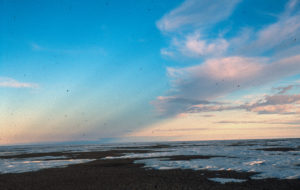
Flying from Fairbanks the other day was amazing. It was clear almost to the Brooks range; there were several large, wide, meandering rivers and dozens of smaller streams. Sometimes there were three or four rows of oxbows with the current channel carefully hidden among the old. The mountains were sharp and straight-edged. There was snow everywhere.
Eventually, it clouded over, and we flew over the range without ever seeing it. Approaching Barrow, I saw open water and then pack ice, mile after mile of pressure ridges and leads. Like giant, dry salt flats, cracks led every which where and the pressure ridges ran in long intersecting lines…
An older Inupiat couple came across the ice yesterday. He drove the snow machine; she sat in a chariot sort of sled. They came from the mainland to collect firewood off the beach. It’s funny that in a land with no trees driftwood is plentiful. We talked a while; they were surprised I would be here alone through the summer and said I should radio anytime. ––– was their call, channel XX.
He wore a simple over shirt, long and lined with sheepskin, the ruff on the hood was magnificent wolf fur, it flowed and moved in the breeze as if the fur itself was alive. It was silvery bright with black tips. The man was sun-darkened, almost the color of dark chocolate, and was creased and aged, the ruff danced around his face and made him beautiful. The woman was quite small and also quite round.
She talked about her grandchildren and daughter-in-law and about collecting wood, their camp here, home in Barrow, and their winter home in Anchorage – the south, you know. She was lively and chatty in a way that was familiar and pleasant. It was nice to have these visitors.
Later, I walked through the snow and across the island. I watched the fat, lazy seal basking in the hazy sun over its breathing hole. Two Pomarine jaegers sailed by; a flock of 60 or so common eiders wove their way across the ice, they disappeared behind pressure ridges and came out again into view. Eventually, they found their way into single-file and went off toward the lead to feed.
A short-eared owl played tag with me, gliding near and past before I noticed how close it was. It landed and watched me for a long time, as I watched it. When I approached, it lifted off, glided away, and landed on a peak of the pressure ice piled up on the north shore.
The wind goes on. I haven’t been out to check on even the existence of the other tent. It may well have blown away by now. The food, stove, and I are crammed into half the tent as the wind has the other half pushed flat up against me. There is snow in the air.
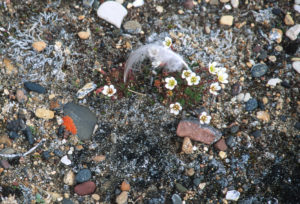
Cooper tundra
Join me this fall on The Road not Taken Enough when I go to Svalbard on an Arctic Circle residency Artistry in the Arctic.
Like this:
Like Loading...
by aramatzne@gmail.com | 18 Mar 2018 | Roads Taken
Part 5. The continuing saga. Still 1 June 2000.
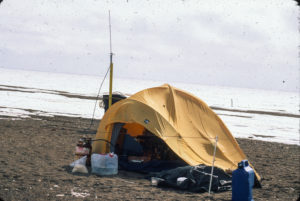
A little wind
In theory, the guillemots will be back within the week. Given the snow cover, the cold, now the pelting rain, I hardly expect them at all. It is hard to believe any creature would choose this place to start a family. It is, actually, quite beautiful and I am sure that when the snow melts, the pack ice recedes, and the 8’x10’ patch of tundra greens it will be even more so. There are Brant that nest here, greater white-fronted geese, and, in the past, large herds of Arctic terns. The snow buntings have been singing and chasing around since I’ve gotten here. I am happy to give them my oatmeal; they seem to enjoy it more than I do.
Although the sun has really not shown itself, I have been aware of its journey around the horizon. The difference in light during the day and night is muted by the hazy sky and heavy clouds, but the change in temperature is obvious. The first morning it couldn’t have been more than 15ºF – the radio said it was 19º at 5 am but I was up at midnight and it seemed colder. When I woke this morning, it was dead calm, and I knew something was coming. The wind now is out of the south, a Beaufort 5 or 6 (19-30 mph). The rain fly is pushed up against the wall rendering any waterproofness useless. The rain comes and goes. The wind continues.
The snow bunting sings its cheery, bright song. I drink more hot liquids. I wander out now and then to reinforce, stretch, fill garbage bags with snow for drinking water in July, empathize with the birds, scan for bears. I should be well read by the end of this.
The rain seems to have stopped. The wind has increased by a couple of notches. I am due for a radio call in ten minutes. I will be lucky if the antenna doesn’t blow off when I raise it. The white-crowned sparrow is still working the edges of the camp. There is a glaucous gull having an absolutely fabulous time playing in the wind, two Pomarine jaegers just screamed past. Perhaps the wind will blow out all the clouds and clear the skies. But, given that it’s from the south, I doubt it.
Aborted radio call. My sleep tent moved about ten feet across the island before I hauled more gear into it. The cook tent, where I’m sitting, is folded in half; sitting in the middle of the tent, the south wall is pressed against my shoulder. The fiberglass extender for the antenna wanted to shatter but flexed about in half trying not to. I guess everything that was soaked by the rain will dry in a short time.
The sparrow and bunting only come to feed when I am out of the tent, and I have my back to them. They will land 10 feet from me when they can see me standing there but not at all when they know I am in the tent. Buggers.
Hours later: The forces of good and evil are at work here, battling for control of the Arctic.
I just stepped out to take a photo of the tent being folded in half by the wind. I was barely able to stand against it but had to do something other than sit. I can see the bluffs six miles to the south. They stand out, clear and sharp. Immediately above them is a wall of cloud thick and heavy. Over me is another massive bank of cloud. Everything west and north is gray down to the horizon. Between me and the bluffs is blue sky. The wind is straight out of the west, off the Bering Sea. I can see the snow slanting across the lagoon and now and then there is a sharp spit of it right here. The wind has increased since this morning. I put a Halberton case full of books and a10 gal propane tank in the other tent to help keep it in place.
I just made another cup of tea. I shut the gas off earlier, afraid of the unpredictability of wind and fire. Given that both sides of the tent are almost directly over the stove I thought it might be a good idea. I shut the gas off again and finally was able to zipper shut the door – there are several broken teeth, which make it a challenge. Although it keeps the sand out and holds back the wind a bit, I am now cut off from the view – snow, ice, sky, and the occasional bird. It is much more claustrophobia-inducing this way.
I bought a wooden flute before I came here. I’ve wanted to learn to play for a long time and thought here no one would have to suffer through the initial squeaks. Each time I bring it out the wind seems to pick up.
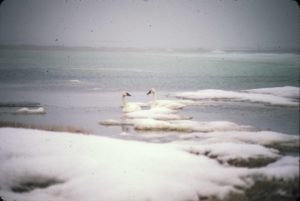
Swans stop for a visit.
Join me this fall on The Road not Taken Enough when I go to Svalbard on an Arctic Circle residency Artistry in the Arctic.
Like this:
Like Loading...
by aramatzne@gmail.com | 15 Mar 2018 | Musing
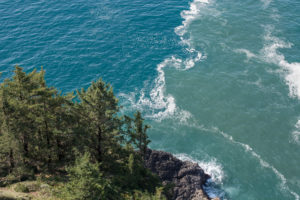
Swirling ocean patterns draw me in. Cape Lookout, Oregon
Like this:
Like Loading...
by aramatzne@gmail.com | 11 Mar 2018 | Roads Taken
Part 4. The early days on Cooper, sky, sand, and bear alarms. 1 June 2000, continued.
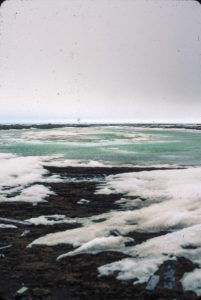
Spring is gaining ground. The snow and ice recede.
It is 6 am. I have been up since midnight. It started to rain at 1. It is about 33º. I am lying in wait, camera ready, oatmeal strewed, for one of many snow buntings and one white-crowned sparrow. I consumed about all of the hot liquids I can tolerate and am considering switching over to the scotch. So what if it is early morning?
The rain patters on, the tent is steamy. Of course, the steaminess of the tent is detrimental to my hopes of any good photos since the lens is in a constant state of fog but I have lots of time and may as well feel like I am working at something.
The other day in Barrow, I was fooled by the sky. The pack ice stretches from shore away to the west. The low clouds reflecting a small lead out on the water gave the illusion that the ocean was open just offshore, that after a couple hundred yards there was open water, not just pack ice. There was nothing distinct about any of them (sky, water, land), flat, contourless, contrast-less. Unbearably desolate in that flat, grey light.
I’m not sure how this always happens. For someone like me, who can talk a mean streak, I do always seem to fall into company with those that can outdo me in their sleep. George can talk. Among all the other bits of life that he can cover he has 30 years’ worth of summers on Cooper Island. He talked about coming out this time of year and setting up the tents 50 yards out on the pack ice, not knowing it until the ice started to break up. Having matches dropped from a plane, they spontaneously ignited on impact. Finding a polar bear sleeping behind one of the nest boxes he was checking. Having a black guillemot line up and explosively shit into his face, a fluid stream of digested fish rapidly-propelled, as he was inhaling to blow the feathers out of the way to check the cloacal opening. It goes on. He is disorganized and, after 30 years of doing this, still seems to need to prove himself. “I don’t need to clean the pot, I just figure out what I can cook that will complement what’s left in the pot from the last meal.”
Since he was only here for a couple of days he slept in the cook tent. Before his snow machine was 100 meters from camp I began emptying everything out so I could dump the 45 lbs of sand he had imported to the tent’s inside. His goal, he said, was to have enough sand in the tent to be able to drain a pot of hot pasta directly onto the floor of the tent by the end of summer.
I hate sand. Some people get into their tent to get out of the wind. I get into the tent to get out of the sand. I like it under my bare feet. I like it on the beach. I hate it in my tent, in my food and my bed. This is a man who left here with a cell phone, a hand-held two-way radio, a GPS unit, and a personal locator beacon to find his way back to Barrow, but won’t bring a shovel to the island because it is too technologically advanced. Egad. He’ll be back 12 June.
There are three cabins I can see from here without binos. They are six miles away across the lagoon. George says at times you can see caribou walking on the bluffs to the east of the cabins.
I collected four dead birds, two male and one female common eiders and one male king eider. Apparently done in by an owl – short-eared, maybe snowy. The feathers are magnificent – soft as eiderdown, thick, and luxuriant. The birds just happen to be missing all of the flesh in their breasts and on their necks. The wings and bodies are untouched otherwise, the meat carefully excised with hardly a feather ruffled, pun quite literally intended.
There is a rather ingenious bear perimeter alarm set up around the camp. A rattrap wired to a car alarm with a plastic plug set under the trip wire. When the connecting cord, that encircles camp, is pushed out of line the plug pops out and the alarm sounds. A bear meandering into camp is not likely to step over the cord to avoid the hated car alarm. There have been a lot of bear sightings and a few encounters this year. One bear has been killed. I sleep with a loaded shotgun and carry pepper spray. As I wander farther from camp for longer periods of time I will carry the gun with me. They say slugs are effective on charging bears.
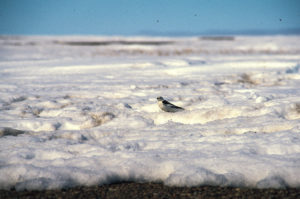
Snow Bunting
Join me this fall on The Road not Taken Enough when I go to Svalbard on an Arctic Circle residency Artistry in the Arctic.
Like this:
Like Loading...
by aramatzne@gmail.com | 4 Mar 2018 | Roads Taken
Part 3. The following excerpt was actually written upon my return to the lower 48 but it so amazed me that I have to share it. Back to the regular Arctic programming next time. Honest.
“I am going through cash like crazy. I had a few minutes of panic this evening when I filled my gas tank and it was $13.”
Whoa. That’s not just a different decade but a different universe.
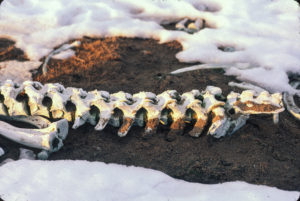
On the backs of giants
Join me this fall on The Road not Taken Enough when I go to Svalbard on an Arctic Circleresidency Artistry in the Arctic.
Like this:
Like Loading...
by aramatzne@gmail.com | 25 Feb 2018 | Roads Taken
Part 2 in a series of journal excerpts from time in the Arctic
**note: photos in these posts are from scanned slides… that desperately needed to be cleaned…
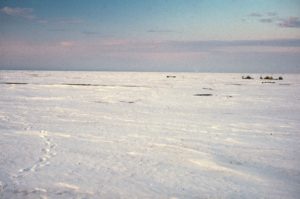
Cooper Island Camp
I never cease to amaze myself. I am comfortably ensconced in a mostly dry, not very large tent on a small patch of open ground on a large, flat, frozen-in island. The land, the water, and the sky look all the same. From the sand and gravel that stretch ten feet in front of the tent the snow begins and goes on until it merges seamlessly with the pack ice. The pack ice, in turn, merges with sky somewhere along an indistinct horizon.
Now that I have found pseudo fly poles for the tent, I sit with my camera on the tripod attempting to lure snow buntings and a hapless white-crowned sparrow to eat leftover rice and a handful of dry oatmeal. They sneak in and disappear again before I realize my chance is gone.
The rain sounds nice but I am glad to be out of it. It is 33ºF, 0530, and the sun has been up since 10 May. That sounds funny. It hardly gets any less light at night than during the day – there is a different quality to the light, it is flatter and offers less contrast to the world. Though I have hardly seen the sun, as it has been cloudy and gray since I got here, it is fascinating to see it circle the horizon – the 360º horizon. Yesterday there was an immense, distinct sundog which I praised and was thankful for. It didn’t occur to me that it would bring rain. The mackerel sky tipped me off on that.
So, how did I arrive here? My usual convoluted way. Cool, I’ll go to Alaska for the summer. Indeed. I arrived in Barrow, via Detroit, Seattle, and Fairbanks. It was 20º when I arrived. Not bad for the 28th of May. I guess that is even cold by Alaska standards for so late in the spring. My boss, George, and I stayed at the research facility in Barrow one night. Collected up all the gear we hadn’t already gathered in Fairbanks, bought more food, raided the facility stock room and, with the help of two research staff, piled everything onto two snow machine sleds, piled ourselves on – two driving, two (including me) standing at the sled back – and set out across Elson Lagoon to my summer home away from home, Cooper Island.
It was interesting to come across the great flat water, the sleds moved across, around, and through the pressure ridges in the ice. It was trackless, with exception of some fox tracks, there were no landmarks, no sun in the heavy sky to guide us, and yet we mostly made a straight line to the island, 25 miles east of Barrow. Flocks of common eiders, low to the frozen surface, crossed the horizon. Greater white-fronted geese talked their way across the sky.
We set up the tents, stowed gear, and set up the polar bear perimeter alarm. The research guys headed back to Barrow. George and I were left on a flat, featureless island.
It was mostly still under snow and, except for a few bare spots, in one of which we set up the tents, it was hard to believe that it was any different than the pack ice on the lagoon. Apparently, one year George actually did set up the tent on the pack ice, not realizing the island shore was 50 yards away. Oops.
George showed me the island, briefed me on what I need to do over the next two weeks while he is away and two days later he took the snow machine back to Barrow. So it comes to pass that I am alone on a barrier island in the Arctic Ocean. Frozen into the lagoon, frozen into the island, and for all practical purposes, frozen into time.
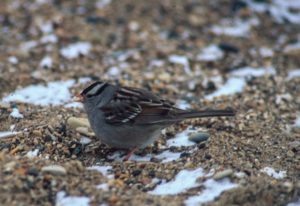
The hapless white-crowned sparrow.
Join me this fall on The Road not Taken Enough when I go to Svalbard on an Arctic Circle residency Artistry in the Arctic.
Like this:
Like Loading...
by aramatzne@gmail.com | 21 Feb 2018 | Musing
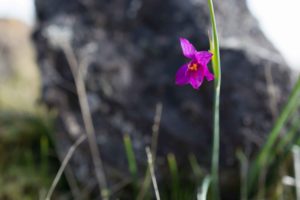
A grass widow on Lower Table Rock, Oregon.
Spring arrived before winter, and it came in dayglow.
Like this:
Like Loading...
by aramatzne@gmail.com | 18 Feb 2018 | Roads Taken
In preparation for my upcoming residency with The Arctic Circle in September and October, I will post a series of photos and journal entries from previous time spent in the Arctic. I hope you enjoy this introduction and I hope you’ll join me here this fall when The Road not Taken Enough returns to the Arctic. xoxo T
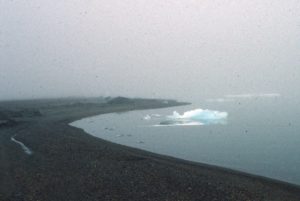
The fog
Part 1 – Sensory deprivation
I’ve been walking since I got up this morning. And eating of course. The wind and rain of the other day passed finally. Yesterday was foggy and freezing. Everything was covered with a thin sheet of ice. It lifted briefly in the afternoon and got warm for a spell.
This morning when I awoke the air was absolutely dead calm and the fog as thick as it has ever been. And so, I walked, and took photos, and walked more. There is an absolute silence and stillness to the world that is unmatched by anything I’ve ever heard or felt. Even intensely cold days in the north woods have a feeling of motion. This is absolute.
There is sensory deprivation on two levels, sound- except for a few birds, my own footsteps and the almost imperceptible wash of water on the shore, but these things you must work to hear. And visual deprivation -the water, both the lagoon and the ocean, is so utterly calm that they perfectly mirror the sky and the fog, so all sense of a horizon or a division between land and water is gone.
All sense that you are seeing anything at all is gone. If my mind didn’t override my visual input and tell me about the fog I should think I was going blind. Visibility is very low across the land but to stand on the edge of the water and look into the great grey void created by the sky and water uniting in color and texture is to truly experience emptiness. And to feel as if I am on the edge of the world.
Now and then, on the lagoon side, a dark spot that is a loon or a long-tailed duck will break free of the fog and show itself giving a definitive life to the water and proving that there is more than one dimension to the space in front of me.
On the ocean side, there are icebergs looming in the water, moving imperceptibly across the surface. And often, they calve. The sound travels through the fog, across the water, that distorted fog sound. But to look out to the ocean there is no change, no motion, no acknowledgment by the water or the air that the balance between ice and water has shifted. Only silence once again.
Occasionally a red-throated loon gives its eerie, raspy, almost desperate call, though no loon is in sight. I know it is out among the icebergs, bill pointed up to the foggy sky and its head cocked to one side or the other, listening into the silence for an answer, or for any sound. Some proof that the rest of the world still exists and it isn’t only in the imagination that there was once wind and motion, sounds of water washing against the shore, or the persistent calls of numerous other birds.
I took many photos of this deprivation of sight. Some hard fast object in the foreground with the limitless depths of fog gray void behind. How does one record the lack of something to see with a camera? I’m not sure. If there is anything to see in my photos, any depth or contrast, any color, any motion, they will be stupendous indeed. If not, they will be flat, gray, ambiguous portraits of just what I sought to record, the lack of something to see.
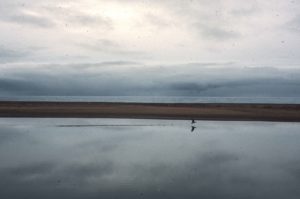
Take off
Join me this fall on The Road not Taken Enough when I go to Svalbard on an Arctic Circle residency Artistry in the Arctic.
Like this:
Like Loading...
by aramatzne@gmail.com | 31 Jan 2018 | Musing
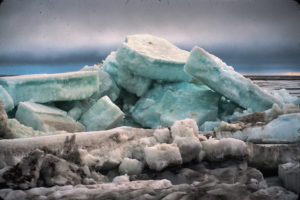
Sea ice break up
The Philosophy
We put thirty spokes together and call it a wheel;
But it is on the space where there is nothing that the usefulness of the wheel depends.
We turn clay to make a vessel;
But it is on that space where there is nothing that the usefulness of the vessel depends.
We pierce doors and windows to make a house;
And it is on these spaces where there is nothing that the usefulness of the house depends.
Therefore just as we take advantage of what is, we should recognize the usefulness of what is not.
Dao de jing
The science and art
The first time I went to the Arctic, I rode to the island that would be my summer home on the back of a cargo sled pulled by a snowmobile. It was the last weekend in May 2000.
Two snowmobiles, two cargo sleds, four people moved across the open ice of the Arctic Ocean, flat, cold, and boundless. Flocks of eiders and long-tailed ducks hung low along the horizon following their ancient rhythms to nesting grounds still frozen into the tundra.
The majority of that summer I lived on the island alone. It snowed, it rained, there was fog, there was a hurricane, the wind rarely ceased. And I was in frozen heaven.
In our over-caffeinated, over-extended, over-scheduled lives, the Arctic is the space upon which the usefulness of the world relies.
Out of sight to most, it is one of the great regulating factors of the Earth. Now more than ever its vast emptiness is useful to us all.
Formally trained as a biologist, I recently expanded my focus to include writing and photography as a means of connecting more people with the wild world. Combining these skills is a way of fostering innovative thinking and dialogue between people and disciplines with the intent of bringing positive change to the environment. To that end, I applied for and was accepted to an art and science residency titled The Arctic Circle in Svalbard, Norway, in fall 2018.
I intend to create a written and photographic weaving of my journals from my earlier time spent in the Arctic, with climate change science, and the experience of returning to the Arctic as a writer and photographer 18 years after my first visit as a biologist.
The request
I have started a GoFundMe campaign, Artistry in the Arctic, to help fund this expedition. I am requesting funding to cover the residency fee, airfare, and a few necessary expenses of autumn in the Arctic. Generous friends and family, some of them brand new friends and family, have already donated almost enough to cover the deposit due in March. Please consider contributing any amount you are able. Small donations add up, and with your help, we will all go to the Arctic for a new adventure as – internet access dependent – I will post as much as I can along the way.
I set rewards for different donation levels – your choice of any photo that I post during the trip, signed and delivered to you.
For more information and to donate, please visit:
Thank you. Thank you. Thank you.
xoxo T
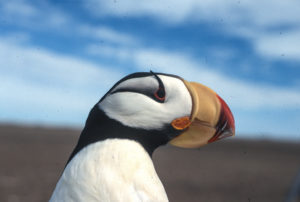
Puffin in the house
Like this:
Like Loading...
by aramatzne@gmail.com | 29 Dec 2017 | Musing
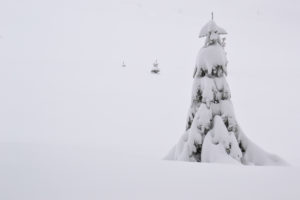
The winter mind.
It seems my mind is both full and empty.
I think about a time when my neck doesn’t hurt, and the tendons don’t grind – these days are both past and future.
I think about Big Cat, a cat the color of fallen oak leaves.
There is blank space where my mind struggles to find something to think.
I think about —- and his careful and attentive questions about my well-being.
I think about —–, how I will get the job there. How I will be if I haven’t gotten the job.
I think about the oaks and pines outside my window and the pieces of the sky I see through their bare branches and needles.
I try to think of something to write, and I see nothing.
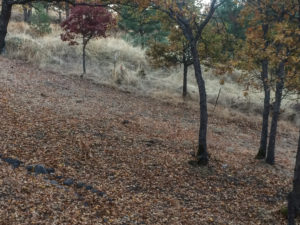
A cat the color of fallen oak leaves.
I think about visible and unrecognizable, the words that chose me for 2017. I wonder what words 2018 will bring me. I don’t see them. My mind says I can’t see them. Maybe they will see me as 2017’s words did.
Enough comes to mind. As in, “I am enough,” or “I have enough,” or “This is enough.” I am content to let this sit for now. It is enough.
A more visceral part says to me, “No. All this is true. And I am more. I can do more. I can be more.”
Enough and more? Similarly contraindicated as visible and unrecognizable. Not opposites. Not opponents. Co-workers. Collaborators. Co-conspirators.
Becoming visible was an act that made me unrecognizable to many. Becoming unrecognizable allowed me to be visible to many more.
Being enough can allow me to be more. Being more offers enough to others.
Yes. Maybe these are the words I need.
I am enough. We are all enough.
I have always been enough. We all have always been enough.
I have more. I am more. I offer more. Striving for more opens me to…
I go back to the blank mind. There are pieces of thoughts, glimmers of ideas floating about in there. I can almost see them. I can’t quite feel them. Beyond the list of what to do today, tomorrow, and next week, there are much grander thoughts. They need to be let out. Hoarding them produces a feeling of scarcity – if I let this into the world, there will never be another, and I will be without grand ideas. No. That’s not right. Letting them out into the world brings them friends and community. It allows expansion, the ideas grow and multiply.
Here is an idea:
What if each of us believes that we are enough?
And,
What if each of us believes that every other person is also enough?
We would all have more.
Like this:
Like Loading...