I took this photo: They must have been closed
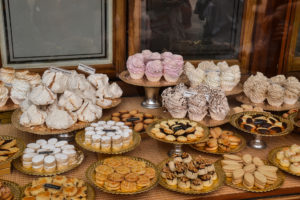
Dive through the window
I took this photo but I didn’t eat a single thing.
They must have been closed.
I can think of no other explanation.

Dive through the window
I took this photo but I didn’t eat a single thing.
They must have been closed.
I can think of no other explanation.
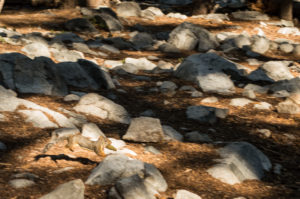
Fall caching; squirrel on the move.
This is a cautionary tale.
A chipmunk spent its morning trying to pilfer any bit of food it could find from my campsite. The food was packed, hung, and covered. There were no bits lying around, no dirty dishes, no tossed veggie scraps. The chipmunk tried every angle, checked every stuff sack and container to no avail.
Meanwhile, a squirrel spent its morning dashing through the campsite. It collected cones in trees near the lake, ran through camp with a cone in its mouth, and then into the alders along the edge of the lake’s outflow meadow. A few minutes later, having stashed the cone in some secret place, it would run back to camp, stop to look at me over my pack or across the fire ring, and then continue on its path. It didn’t disturb any of my things or even sniff at the stuff sacks. Every five minutes it made another roundtrip through camp.
After a couple of hours, the chipmunk was still angling for something easy and free, although it seemed to have less enthusiasm at this point. It stopped to scold me occasionally as if to say, “How dare you! Where is my breakfast?” It would disappear for ten or twenty minutes and then reappear to once again check every item. Just in case.
The squirrel also scolded me but it was because I inadvertently stepped into its path when it was crossing camp. Halfway through the morning, the squirrel stopped for a snack – a cone he found near one of his supply trees – and then went back to work.
Returning to my briefly unguarded teacup, I found two tiny droplets on the rock next to it. Inside the rim of the cup, there were two little, wet paw prints. The cup was otherwise undisturbed, not knocked over, no floating debris, just two perfect paw prints.
I took this photo by predicting the squirrel’s movement along the same path through camp. It was reliable, as is his winter food supply. The chipmunk only got wet feet for his morning’s work.
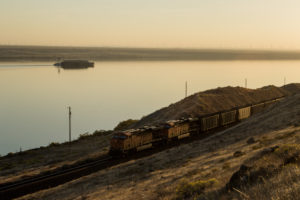
Twilight on the surface
The main stem of the Columbia River has 14 dams on it, including the largest dam in the United States. Within the entire Columbia basin, more than 400 dams generate almost half of the hydropower in the US.
Ship locks at several dams and channel dredging allow navigation from the Pacific Ocean to Lewiston, Idaho – more than 400 miles inland.
In the late 1800s, half a million salmon were caught for canning and export in one season. Today four of the 400 dams have fish ladders.
The river irrigates 670,000 acres of sagebrush desert in Washington. As many as 100 illegal dams on private property irrigate an unknown number of additional acres.
Hanford, a Cold War plutonium production site, is the most contaminated nuclear site in the US. For 27 years radioactive cooling water from the eight plutonium production reactors was released back into the Columbia River. The federal government did not disclose this information until more than a decade after the discharge ceased.
Today, an estimated 270 billion gallons of groundwater have been contaminated by high-level nuclear waste that leaked from Hanford’s storage tanks. A million-gallon plume of that radioactive groundwater is expected to hit the Columbia River within the next 10 years at the earliest and 50 years at the latest.
I took this photo in the fading evening light of a typical Columbia River day. Train tracks, carrying coal and oil trains, parallel both banks; grain and coal barges ply its waters; Interstate 84 flanks its south shore; thousands of wind turbines, just visible on the far shore, stand sentinel to the north and south; the slow, warm, slack water impounded behind another dam holds fish that can’t move downstream fast enough and can’t move upstream at all; the final ingredient in the cocktail is three decades of nuclear waste in the water and sediments. The calm water and the pastel light are a lovely façade on a tenacious, living body of water that miraculously continues to survive.
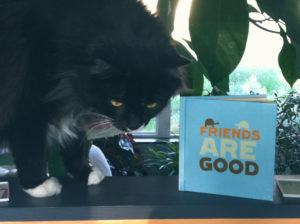
Little Cat recommends her favorite book.
I took this photo; it needs no explanation.
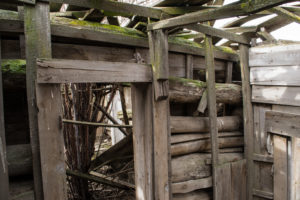
There was no display of huge teeth or horrible monsterness.
Abandoned buildings have long held intrigue for me. Who built them and why did they leave? Where did the builders come from and how did they get there – were they escaping hardship elsewhere or pursuing the dream of their own land? Did they arrive by wagon train or on foot? Where did they go? Did they die in some tragic pioneer episode – botulism or a massacre? Did the wind or the loneliness drive someone mad enough to murder their family and walk off into the winter? Perhaps a more pleasant scenario, a bachelor farmer married the love of his life and moved to town. Or the family outgrew the honeymoon house and built a new home closer to water or in a more protected location. The possibilities are endless.
Then, of course, there is Monty Python. Yes, I know this sounds like a non-sequitur. Remember in Monty Python and the Holy Grail when they arrive at the cave where the Grail’s location is written on the wall? The cave is guarded by a most horrible monster with huge teeth.
As the knights sneak up to the cave and look upon the entrance they see a rabbit quietly grazing. The knight, aghast at the idea of fearing a rabbit, berates his squire, “You bloody tit! It’s a bunny rabbit.” The assault on the cave does not go well but eventually the knights prevail, the rabbit is slain, and the final words of the dying man who wrote the location of the grail are revealed. “The holy grail is in the castle of Aaaaaaaaaaah.” Unable to complete the sentence before dying, the man merely wrote his last gasp rather than the castle’s name.
This still makes me laugh. And I still quote this movie more often than I care to admit. I mean, sometimes it’s just necessary to exclaim, “She turned me into a newt!”
Right. Abandoned buildings. I often trespass. It’s not always intentional and it’s certainly never in the form of walking up to someone’s house and peering through the windows. Unless, of course, the house happens to be abandoned.
I’m fascinated by the construction, by the things left behind, the things that have moved in, the sounds, the views through the missing windows or the leaning doors, even the smells. I’ve found whole barn owl families, pack rats, phoebes, barn swallows, cows, horses, and trees living in abandoned houses, stoves with pots on them, closets with clothes still hanging, curtains at the windows, and pantries with dishes, bottles, and tins.
As I debated whether this particular building was too far from the road for relatively unobtrusive trespassing, a pickup stopped, the driver rolled down the window and told me I was welcome to take a look. Dilemma solved.
It was built with logs and had been expanded, the stacked logs of one structure butted against the cut logs of the addition. The roof had mostly collapsed and an elderberry shrub grew in the middle of a room up through the roof joists. Shreds of wallpaper hung in a few ragged sections – it was cloth with frayed edges and a delicate, pale green leafy pattern still visible.
There was a door between the old section with the log cabin-style stacked corners and the more recent addition. Picking my way through the litter on the floor and ducking under the fallen logs, I stepped through the door and slowly turned to view the whole room, to look out of the windows, to look back into the old house.
And then I saw that I was not alone.
A shiny black bunny eye and twitchy nose were the only giveaways. Perfectly colored and absolutely still, there was no display of huge teeth or horrible monsterness. Just a bunny hanging out above a door in an abandoned house. But… how did it get there? Where did it come from? Did its family get too big and expand into this new home? Maybe it was a bachelor bunny courting a cute girl bunny in a downstairs condo. And who knew rabbits could climb walls?
I took this photo for the sheer delight – it is not often you find a rabbit watching from above a door frame. There was no evidence of rabbit viciousness but, sadly, also no scrawled note telling me who the people were or where they had gone.
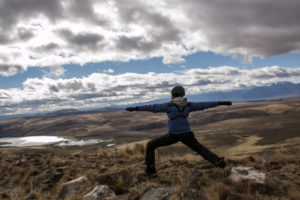
Warrior II fashion: snow pants, Sorels, and a hard hat.
The US yoga industry has exploded in recent years: hot yoga, power yoga, radiant flow, restorative, aerial, zen bootcamp (huh?). As the yoga possibilities have expanded, so too have the clothing opportunities. From its perhaps simplistic origins to a $27 billion industry in 5000 short years. No, wait. That should be 4990 years of yoga and 10 years of booming industry.
Being outdoors all day, in one place, in the cold requires warm clothing, a massive quantity of fuel to stay warm (hot chocolate with heavy cream and butter, please), and enough movement to create heat without sweating.
Enter yoga.
Over the years, the fashionable yoga set has moved away from the simple, but ever elegant, loin cloth. Today’s yoga togs (such a good word too often unused) are something to behold. Strappy tops that require a Ph.D. and schematics to put on properly rule the current scene. Leggings of all lengths and body-hugging forms are standard. Fabulous colors, incredible patterns, material cutouts, and built-in multi-layers compete across the studio for attention.
Enter Tamara.
The common comment that my fashion sense elicits is that I always look put together. To me, this implies that each of my body parts is in its proper place and covered with the appropriate and corresponding clothing items. That seems the least (and apparently the most) I can do in the realm of fashion. So be it.
Ski pants, insulated boots, gaiters, a down coat, binoculars (with harness), and a hard hat seem well beyond the height of yoga fashion. I took this photo for the seeming incongruity of the activity and my clothing. I only have a Master’s degree; I couldn’t get into the strappy things.